
Connect the data, expand research
Bring sequence, structure, omics and scientific literature together around molecular, target and disease questions to inform design and analysis.

- Secreted
- Membrane
- Intracellular
- Other
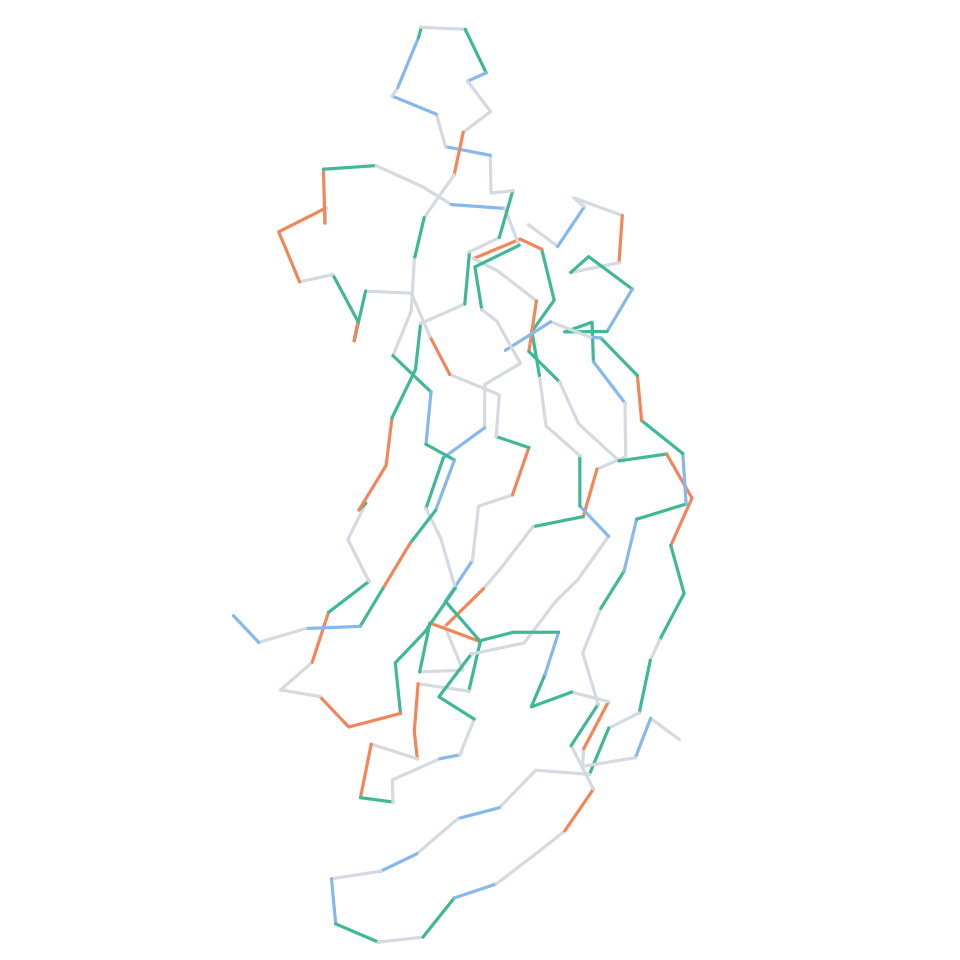
Each point is a human protein · Data: UniProtKB/Swiss-Prot (CC BY 4.0)
Each point is one reviewed human protein, with similar ESM-2 embeddings close together and colors from UniProt localization; the arrow keys turn it.1.14M+
2,527
Million-scale sets
Tens of millions
TB-scale
Molecule types in the molecule–target pairsmAbVHHscFvFvFabBispecificsOthers
Different perspectives on the same molecule
From amino acid sequence to conformation, and from cellular context to experimental behavior, connect the information that shapes molecular research.
Sequences and molecular encoding
Explore amino acid sequences, protein families and evolutionary relationships as foundations for molecular design.
Structure and conformation
Connect molecular conformations, binding interfaces and sequence changes to study structure and function.
Omics and cellular context
Study biological processes and molecular environments through single-cell analysis, transcriptomics and proteomics.
Molecular and drug research
Connect molecular formats, properties and research objectives across antibodies, peptides and conjugates.
Pathways and molecular interactions
Use pathway information and protein interactions to study links between targets and biological function.
Literature and scientific knowledge
Organize literature, patents and research materials to bring existing knowledge to new scientific questions.
Experiments and molecular behavior
Connect findings on activity, binding and other molecular properties with computational design.
Disease and phenotype relationships
Combine disease, gene and phenotype insights to inform target discovery and related research.
Colored by · Physicochemical classBasicAcidicPolarHydrophobic
Data collection and incremental iteration
An automated collection and processing platform and a large-scale incremental iteration framework keep improving the models.
Sources
- Research, industry and company websites
- Mobile apps
- Excel, Word, PDF and other files
Collection
- Request queues with de-duplication
- Distributed collection services
- File parsing
Processing
- Image parsing, text processing
- Cleaning and governance
- Vector database
Storage
- Data warehouse
- Pipeline and molecular data
Incremental data iteration framework
An incremental optimization algorithm built on real-time knowledge updates: it maintains a dynamic dataset, balances old and new data and removes redundancy, easing catastrophic forgetting and mode collapse so models improve steadily over many rounds. It also lets users improve models with their own data, supporting personalized platform deployments.
- Dynamic dataset maintenance
- Old–new data balance
- Redundancy removal
Published in Advanced Science, 2025
Let data inform research decisions
Organize information around research questions and connect insights through computation to develop a shared understanding of molecules.
Connect design with biology
Study sequences, structural features and functional objectives together to inform candidate exploration.
Connect computation with feedback
Use computational and experimental findings to reassess design directions as research develops.
Connect team knowledge with models
Shape analytical and modeling approaches around the materials and methods your team has developed.
Start with your research question
Share the molecules, targets and data needs you are exploring to shape a research approach for your project.