
Understand intent, execute autonomously
- Intelligent task breakdown and planning
- Multi-agent collaborative execution
- Hierarchical decisions with reflective refinement
Not a tool, but your AI research colleague: it breaks down tasks, plans experiments, calls tools and optimizes with you. For protein, antibody and peptide research, MolEX brings the research assistant, molecular models and scientific knowledge into one workspace.
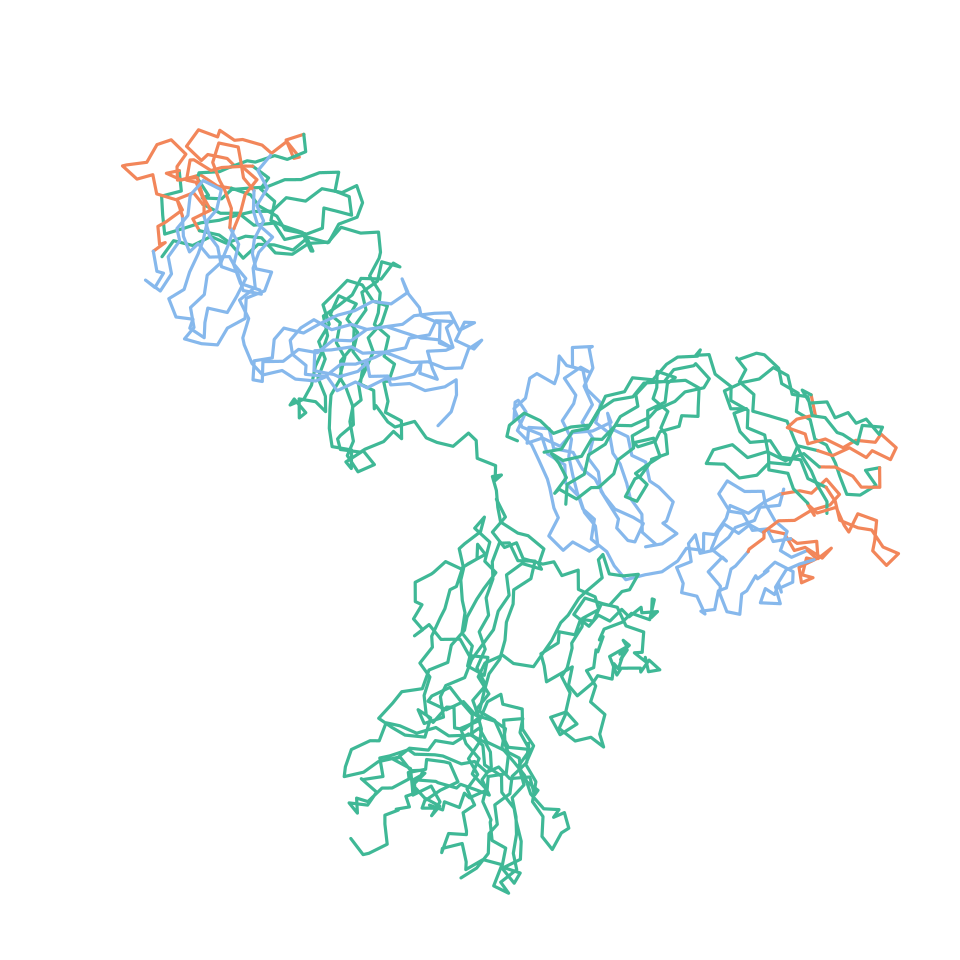
Chain H · heavy chain
Chain K · heavy chain
Chain L · light chain
Chain M · light chain
MolEX AgentPDB 1HZH
PDB 1HZH is loaded. What would you like to know about this structure?
Start with one of these questions:
4 protein chains: H and K are IgG1 heavy chains, L and M are light chains. Each heavy chain pairs with a light chain to form a Fab arm, and the heavy chains’ constant regions join below as the Fc: an intact human IgG1 antibody, b12.
From the N-terminus, each heavy chain runs VH, CH1, hinge, CH2, CH3, and each light chain VL, CL. At the tip of each Fab arm, 6 CDR loops form the antigen-binding site, now marked on the structure. CDR H3 is the longest, at 18 residues.
1HZH is itself the binder, not a target: it is the antibody b12. Its target is the HIV-1 envelope glycoprotein gp120, where b12 binds the CD4-binding site (the complex is PDB 2NY7). To assess a target, load the gp120 structure and ask again.
It starts from one research goal: MolEX breaks the task down, calls tools, asks the scientist to confirm parameters, schedules compute, and delivers structures, metrics and a report.
Read the changelogA hierarchical decision mechanism models how a researcher thinks a problem through, so complex tasks run to completion on their own.
Expert knowledge meets upstream and downstream toolsets; tools evolve on their own, and models grow tuned to each team.
Self-reflective iterative optimization and global–local memory control make retrieval faster and tasks more stable.
See how MolEX connects research activities, from understanding sequences to exploring molecular structures.
All models in the model hub
From file management to custom workflows: one place for every research scenario.
Files and tasks across the platform in one place: sequences, structures, literature and agent outputs, clearly organized.
Upload your own data into a dedicated database; agents learn from it for sharper accuracy in your field.
Search targets, pipelines, literature and other research material, linked to your private knowledge base.
The platform’s in-house and open-source computational models, integrated in one place.
Batch computations and data updates run in the background, unattended.
Research plugins for data analysis, paper writing and more, installed as needed.
Pro users define and upload skills, turn company SOPs into agent-executable chains, and make agents stronger on specific tasks.
Across cells, genes and proteins, explore the structures and connections in multi-omics and single-cell data.
Connect computational analysis and design exploration to help teams focus on directions for further validation.
Explore molecular recognition and binding interfaces using structural information.
Design and evaluate antibody variable regions around functional objectives.
Connect sequence changes with binding behavior to compare and refine candidate designs.
Bring stability, solubility and related needs into the design stage.
Explore protein and peptide sequence space through generative methods.
Use computational models to study how sequence relates to conformation.
Computation informs research decisions. Molecular performance requires experimental validation.
MolEX is an AI research platform driven by large-model multi-agent systems. Describe a research goal in natural language: agents break it into tasks, call models and tools, and reflect and refine as they run, with sequence, structure and multi-property design in one workspace.
Proteins, antibodies, peptides and related biologics. Project scope can be discussed around your research objectives.
Upload your team’s own data into a dedicated knowledge base and turn your research SOPs into workflows; custom collaboration can also be shaped around your materials and methods.
Describe your research question and available materials in natural language, then refine the design and analysis objectives through interaction.
Request a trial or book a consultation on the contact page, sharing your research goals and current stage. We will reply by email.
Book a consultation to explore how MolEX can fit your research.